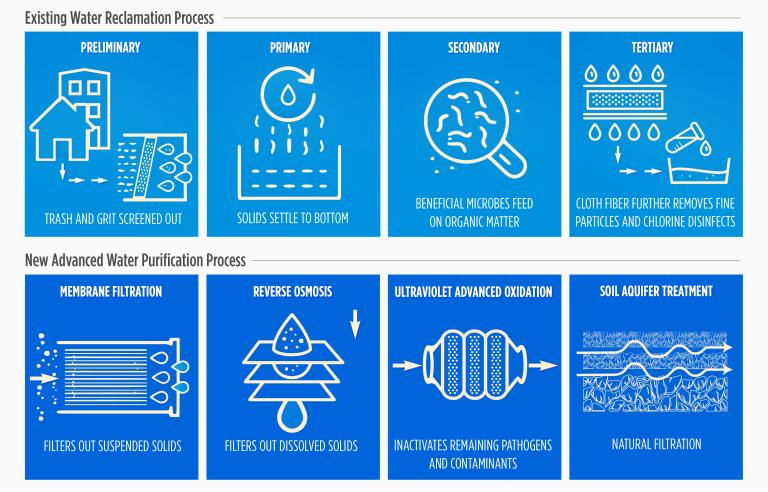
The City of Los Angeles Sanitation and Environment (LASAN) operates four treatment plants in the City of Los Angeles—Hyperion Water Reclamation Plant (HWRP), Donald C. Tillman Water Reclamation Plant (DCTWRP), Los Angeles-Glendale Water Reclamation Plant (LAGWRP), and the Terminal Island Water Reclamation Plant (TIWRP). The treated effluent from the City's four plants is utilized by LADWP to meet recycled water demands both inside and outside the City.
The water treatment process is similar, however treatment levels vary from plant to plant.
- Preliminary Treatment: This takes place as the sewage comes into the plant where the coarse debris and grit is removed through bars and rakes.
- Primary Treatment: Solids are allowed to settle while oils and grease rise to the top. Both settled solids and floating material are removed.
- Secondary Treatment: Here, microorganisms breakdown and remove remaining waste and other small particles, further purifying the water and improve the amount of wastewater solids removed by the organisms.
- Tertiary Treatment: Water passes through sand filters where the remaining solids are removed. Filtered water is then disinfected to kill any additional bacteria, viruses, and microorganisms remaining in the water, making the final product ready for reuse applications.
- Microfiltration and Reverse Osmosis: Both processes function as a sieve, further removing finer particles. At this time, the Terminal Island Water Reclamation Plant is the only plant in the city to produce advanced treated water. Upon completion, the advanced water purification facility at Donald C. Tillman Water Reclamation Plant will also produce advanced treated water through this process.