
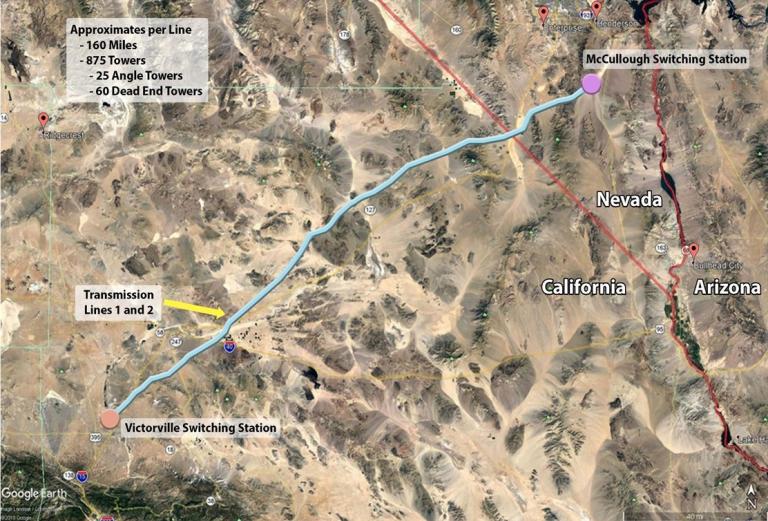
McCullough-Victorville (MCC-VIC) Transmission Lines 1 and 2 are two existing 500 kilovolt (kV) electrical power lines supported on approximately 1,750 single-circuit towers, and spanning over 160 miles from McCullough Switching Station in Nevada, through several mountain ranges, into the Mojave Desert and ending at the Victorville Switching Station in California.
PROJECT HISTORY
In 1936, LADWP placed the first MCC-VIC Transmission Line in service as a 287.5 kV transmission line and then the second MCC-VIC Transmission Line was placed in service in 1939. In 1970, one line was upgraded to 500 kV and then in 1980 the second line was upgraded accordingly.
LADWP had previously prepared an Environmental Impact Report (EIR) for the McCullough-Victorville (MCC-VIC) Transmission Lines 1 and 2 Upgrade Project (State Clearinghouse No. 2024040144). The previously-approved Project would upgrade the MCC-VIC Lines 1 and 2 circuits to newly rate them as 570kV from their current rating of 500kV, including significant upgrades of existing transmission tower steel members and foundation repairs as needed.
Project Updates
Since the certification of the MCC-VIC EIR in October 2024, project design and evaluation of the condition of the existing transmission towers have determined that complete replacement of transmission (rather than just upgrading existing) towers is necessary to ensure long term reliability of power transmission through the lines. By moving forward with the updated project, LADWP will help guarantee that the transmission lines remain safe, dependable, and fully operational for many years to come.
The modification of the existing MCC-VIC Transmission Lines would provide critical transmission capacity and is required to accommodate incoming renewable energy resources along the west of Colorado River Path 46 transmission corridor to ensure the continued safe and reliable operation of the lines.
Both the newly proposed project and previously-approved project support LADWP’s goal to transition to a clean energy future, with ongoing efforts to transition from coal to renewable energy, influenced by Los Angeles City Council’s vote in 2021 to commit to 100 percent carbon-free energy. The additional 475 megawatts would contribute over 15 percent towards LADWP’s Renewable Portfolio Standard as part of LADWP’s commitment to be 100 percent carbon-free by 2035, 10 years ahead of the State’s target.
Project Description
- Complete replacement of 1,750 existing transmission towers that span 162 miles from Boulder City, Nevada to the Victorville Switching Station in Victorville, California.
- The existing MCC-VIC Line 1 alignment will shift approximately 110 feet southeast for approximately 95 miles from the City of Victorville to the City of Baker.
- Installation of new foundations, replacement of existing insulators and hardware assemblies, replacing conductors, ground wire, and re-tensioning conductors, repairing/retrofitting existing main access roads and establishment of new spur roads.
- Construction will require establishing a temporary work area at each transmission structure and pulling and tensioning sites along the entire length of the transmission lines.
- New foundations and tower footprints will be shifted 50 to 300 feet from existing tower sites along the existing centerlines. Access to the project site is available from various existing access routes along the MCC-VIC transmission line corridor.
These transmission lines are a part of 14 high voltage transmission lines that run on the West of River (WOR) Path 46, from southeast California and Nevada up to the Colorado River.
Purpose
Increase LADWP’s share of transmission capacity on West of River (WOR) Path 46 through:
- Transmission line improvements to increase the rating and capacity;
- Allows for delivery of additional renewable energy from the East territory region;
- Increases energy transmission capacity by 475 megawatts (MW) which is equivalent to powering 300,000 homes for one year.
- Provide safe and reliable transmission infrastructure for a minimum of 50 years.
Environmental Review Process
Under the California Environmental Quality Act (CEQA), state and local government agencies are required to inform other agencies and members of the public about the potential environmental impacts of a proposed project, and to reduce or mitigate those impacts to the extent feasible. As the lead agency, LADWP has prepared a draft Subsequent Environmental Impact Report (SEIR) to evaluate the potential environmental impacts of the Proposed Project. A Notice of Availability (NOA) of a draft SEIR has been prepared along with the SEIR and can be accessed in Environmental Reports starting July 16th, 2026. The previously approved EIR and all related documents is also available to view on the same site, under archived projects.
Project Schedule
Mid-2027 through late 2029: Construction
Los Angeles Department of Water and Power
Environmental Planning and Assessment
Attn: Matthew Kerby
111 North Hope Street, Room 1044
Los Angeles, CA 90012
[email protected]
Please remember to include your name and return address so that you can be added to the project mailing list for future project notifications. Your name, address, and comments become public information and may be released to interested parties if requested.
Please ensure that comments are postmarked or emailed on or before August 30th, 2026, the end of the public comment period.
Contact
Project Manager
Nwaoha Lumumba
213-367-3306
[email protected]
Community Affairs
Jessica Johnson
213-271-3369
[email protected]